
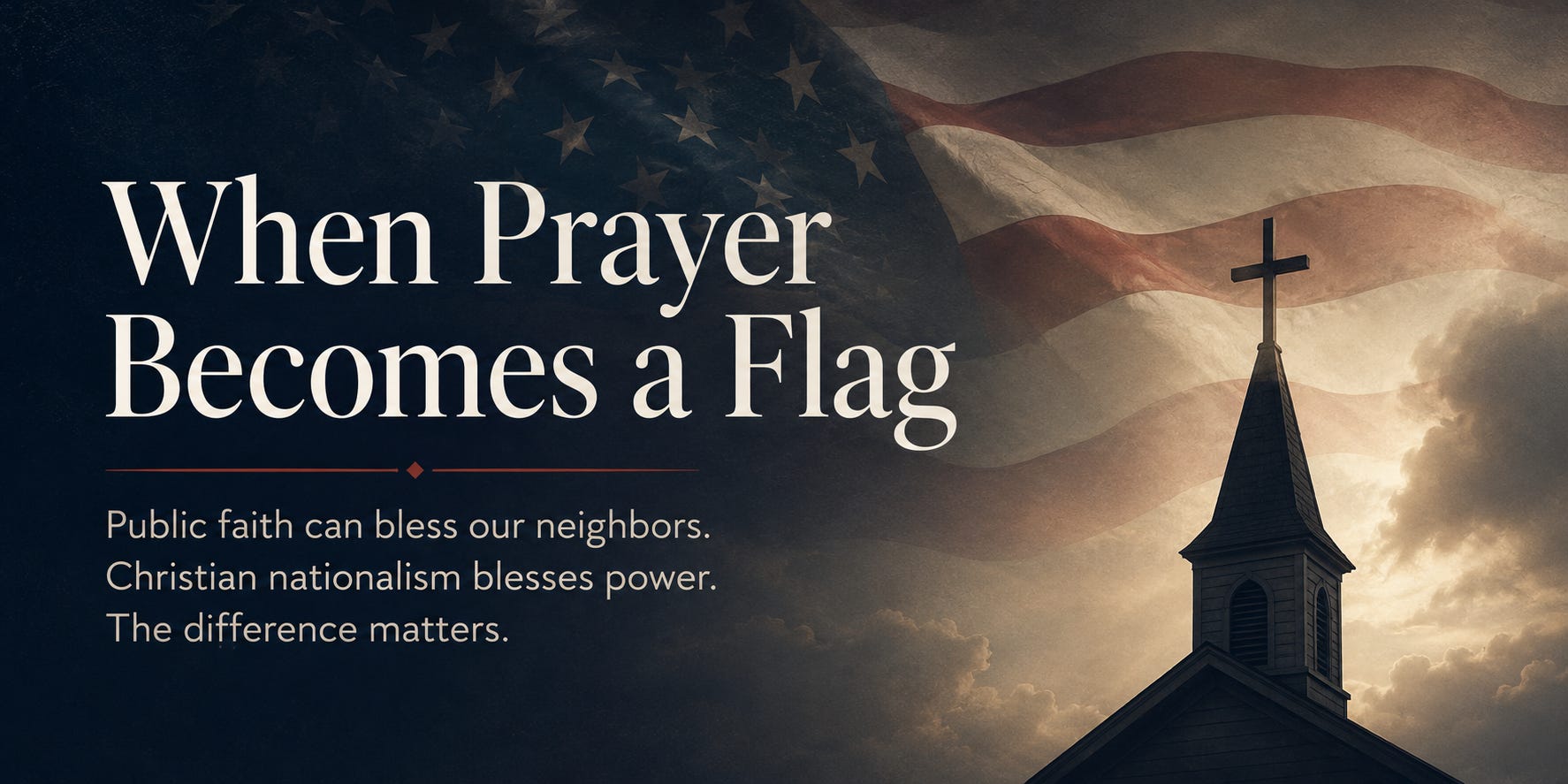
When Prayer Becomes a Flag
Public faith can bless our neighbors. Christian nationalism blesses power. The difference matters.

On Sunday, thousands of people gathered on the National Mall for a Christian prayer rally called Rededicate 250, framed around the upcoming 250th anniversary of the United States and billed as a rededication of the country as “One Nation Under God.” The event included conservative Christian leaders, public officials, patriotic imagery, worship music, and a video message from President Trump. According to AP, it was a mostly conservative Christian prayer gathering tied to the nation’s 250th anniversary. Religion News Service described the event as part of a broader conversation about religious freedom, Christian nationalism, and what America’s founding story means 250 years later.
As a Christian pastor, I am not troubled by people praying in public.
I am troubled when public prayer becomes a flag.
There is a difference between praying for a nation and praying as though the nation itself has been chosen, sanctified, and set above others. There is a difference between asking God to make us more just and asking God to confirm that we already are. There is a difference between faith that humbles power and faith that flatters it.
That difference matters.
Public faith is not the problem
I believe faith belongs in public life. Deeply. Faith should shape how we treat the poor, the immigrant, the prisoner, the child, the stranger, the worker, the enemy, and the neighbor who does not pray the way we pray. Faith should form our moral imagination. It should make us more truthful, more merciful, more courageous, and more committed to the common good.
So no, I do not want a privatized Christianity that only speaks in sanctuaries and never in city halls, school board meetings, courtrooms, neighborhoods, or voting booths. The prophets did not keep their faith private. Jesus did not keep his compassion private. The early church did not keep its table private.
But public theology is not the same thing as Christian nationalism. Public theology asks, What does love require of us in public? Christian nationalism asks, How can Christianity help us claim public power?
Those are not the same question.
The problem is not prayer. The problem is possession.
Christians can and should pray for the country where we live. We can pray for our leaders, even when we disagree with them. We can pray for wisdom, repentance, peace, justice, humility, courage, and the healing of wounds we did not create but are still responsible to help mend.
But when Christians speak of “rededicating” America to God, we should pause long enough to ask what exactly we mean. Are we rededicating ourselves to truth-telling about our history? Are we rededicating ourselves to repair what has been broken by racism, greed, violence, and exclusion? Are we rededicating ourselves to religious liberty not only for Christians, but for Jews, Muslims, Hindus, Buddhists, atheists, agnostics, and everyone else? Are we rededicating ourselves to the Sermon on the Mount?
Or are we rededicating the nation to a story in which America is God’s favorite project, Christianity is the nation’s default identity, and some neighbors are made to feel like guests in their own country?
That is the danger.
Because the moment prayer becomes a tool for deciding who really belongs, it has stopped sounding like Jesus.
Jesus refused this temptation
One of the most important political moments in the Gospels comes before Jesus ever preaches a sermon. In the wilderness, the devil shows Jesus “all the kingdoms of the world” and offers him their glory and authority. All Jesus has to do is bow.
It is a stunning temptation. Not merely personal comfort. Not merely wealth. Not merely fame.
Power.
The power to rule. The power to command. The power to impose. The power to win. And Jesus refuses.
That refusal ought to haunt every Christian attempt to merge the cross with the machinery of empire. Jesus does not reject public life. He does not reject the world. He does not reject the needs of real people living under real systems of power. But he rejects the bargain that says the kingdom of God can be built by bowing to domination.
This is where American Christianity keeps being tested. Not only in whether we believe in Jesus, but in which Jesus we are willing to follow. The Jesus of the Gospels blesses the poor, welcomes the stranger, touches the untouchable, forgives enemies, confronts religious hypocrisy, and warns that nations will be judged by how they treated the hungry, thirsty, naked, sick, imprisoned, and vulnerable.
That Jesus is very hard to wrap in a flag.
The country is not the church
The United States is not the church.
That sentence should not offend Christians. It should protect us. The church does not need the nation to become Christian in order for Christians to be faithful. The church does not need official status in order to love its neighbors. The church does not need political dominance in order to bear witness to the gospel.
In fact, political dominance may be one of the most spiritually dangerous things Christianity can seek. When Christianity becomes a preferred religion of the state, it rarely becomes more Christlike. It usually becomes more useful to those in power. It learns to bless what should be challenged. It learns to excuse what should be confessed. It learns to call domination “order,” cruelty “strength,” and exclusion “faithfulness.”
That is not revival.
That is captivity.
And it is especially dangerous in a religiously diverse democracy, where the promise of religious freedom only means something if it protects everyone. Religious liberty is not the right of Christians to control the public square. It is the right of all people to live without the government establishing one faith as the measure of full belonging.
That concern is not hypothetical. Pew Research Center reported last week that 17% of U.S. adults now say the federal government should declare Christianity the official religion of the United States, up from 13% in 2024. Pew also found that 37% of adults now say religion is gaining influence in American life, the highest share Pew has measured since 2002.
So this conversation is not just symbolic. It is not merely about one rally, one phrase, or one political moment. It is about what kind of public faith we are forming.
Christian faith should make us better neighbors, not more entitled rulers
Here is a test I keep returning to: Does our public faith make our neighbors safer? Does it make the poor more visible? Does it make immigrants more human? Does it make children more protected? Does it make truth harder to avoid? Does it make mercy more likely? Does it make power more accountable? Does it make people of other faiths — and people of no faith — more confident that Christians will defend their freedom too?
If not, then whatever we are practicing may be religious, but it is not the way of Jesus.
Christianity at its best does not need to dominate the public square. It needs to leaven it. It needs to serve it. It needs to tell the truth in it. It needs to stand with those crushed by it. It needs to remind every nation, including this one, that God is not impressed by flags, borders, slogans, or ceremonies if justice is absent.
The prophets said this long before America existed. God does not ask for louder songs while the vulnerable are ignored. God does not ask for more public displays of piety while truth is trampled. God does not ask for national self-congratulation while neighbors are treated as threats.
The prayer God seems to honor is the one that changes us.
So pray for America. But do not confuse America with God.
Pray for America to become more honest. Pray for America to become more just. Pray for America to protect the religious freedom of every person. Pray for America to repent where repentance is needed. Pray for America to care more about hungry children than political theater. Pray for America to welcome the stranger, tell the truth, restrain violence, and seek peace.
Pray for America to be humble enough to know it is not the kingdom of God.
But do not confuse America with God. Do not confuse the flag with the cross. Do not confuse political victory with faithfulness. Do not confuse public prayer with public righteousness. And do not confuse the loudest religious voices in the country with the voice of Jesus.
Because the question is not whether Christians should bring faith into public life. We should.
The question is what kind of faith we are bringing.
A faith that blesses power?
Or a faith that blesses the poor, the grieving, the meek, the merciful, the peacemakers, and those who hunger and thirst for justice?
One of those can be wrapped around a nation.
The other still sounds like Jesus.
And for Christians, that should make all the difference.
Thank you for reading. Paid subscribers help make space for this kind of deeper theological reflection and public faith writing, and I’m grateful for every reader — free or paid — who is part of this conversation.